 پارسی
Seyyed Ali Fotouhi
Seyyed Ali Fotouhi (September 6, 1982 – November 16, 2019)
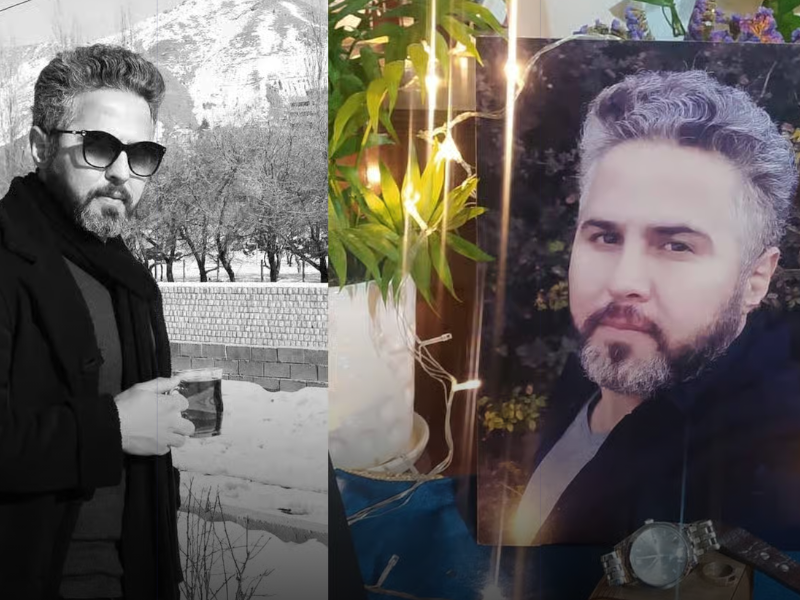
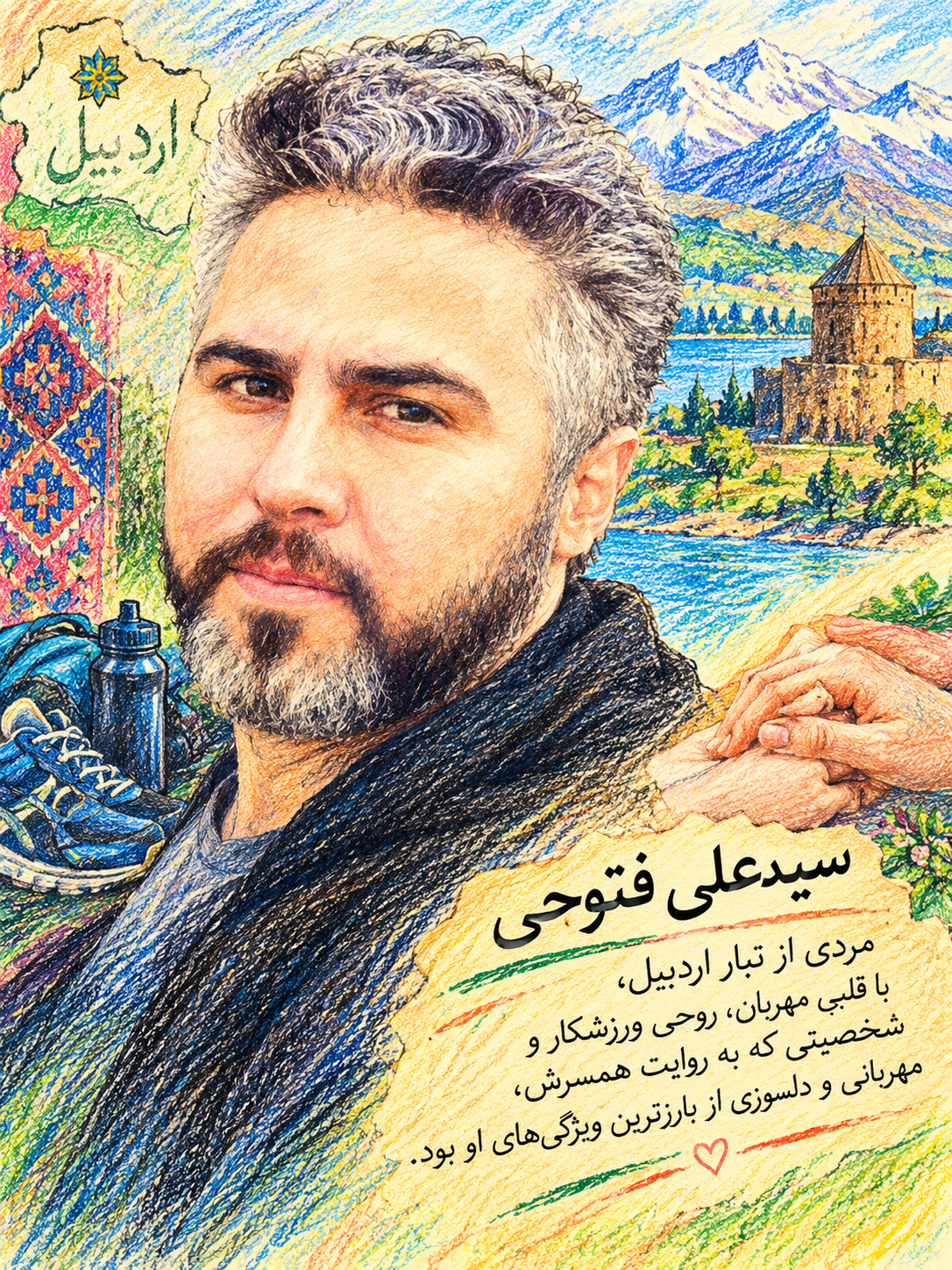
Seyyed Ali Fotouhi was born on September 6, 1982. He was a son of Ardabil, a man with a kind heart, an athletic spirit, and a personality that, according to his wife, was defined above all by compassion and generosity. He was one of those people who would not easily surrender his rights, yet treated others with patience, consideration, and warmth. For Ali, life was more than simply passing the days. It found meaning in loving his family, standing beside his friends, spending time in nature, and caring deeply for the people he loved.
Ali was only six or seven years old when his father died. His father's death left a profound absence in his childhood, but his mother did everything she could to fill that void with love. Ali was the youngest child in the family, and according to his wife, his mother raised him with extraordinary affection, making sure he never felt deprived of anything. Ali never forgot her devotion. His relationship with his mother was marked by respect, attachment, and gratitude. He often spoke of her with affection, saying, “She never let me feel that I had been deprived of anything.”
Those words were more than a tribute to his mother's love. They were the expression of a son who had experienced the pain of losing his father as a child and who understood the sacrifices of a mother determined to ensure that her son wanted for nothing. Ali carried that love with him throughout his life, and it later found another expression in the way he treated his wife.
From his youth, football had been an important part of Ali's life. He played for teams in Ardabil, and his talent and skill on the field earned him the nickname “the Maradona of Ardabil” among his teammates and acquaintances. The nickname reflected the admiration and respect others had for his sporting abilities. Years later, those who had played alongside him still remembered him fondly and spoke of him with affection, recalling their time together on the football field.
But Ali's world extended far beyond football. He loved hiking and was passionate about forests and nature. He was curious about the world and possessed a broad range of general knowledge. He was not indifferent to the people or the world around him. In his personality, the energy of an athlete, a love of nature, intellectual curiosity, and a strong sense of right and wrong came together.
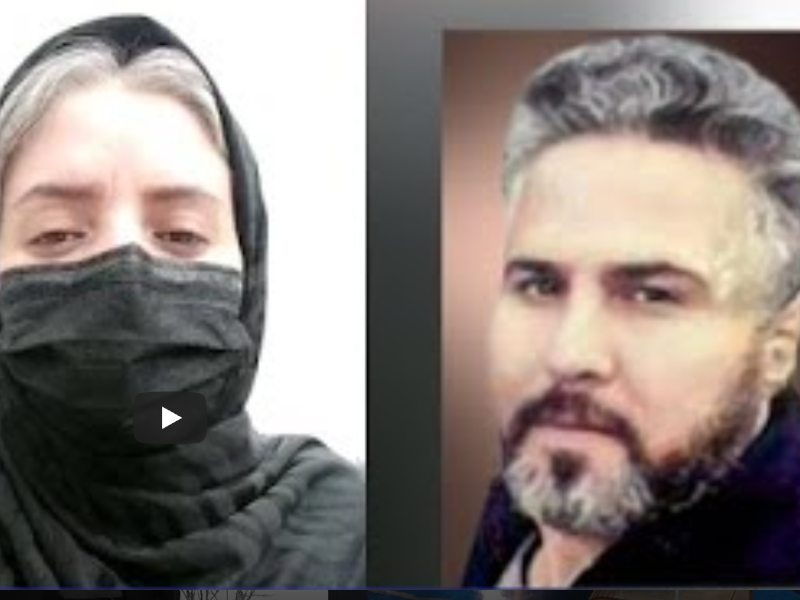
When Ali married Tahereh Bajravani and began their life together, another dimension of his affection gradually became evident in their everyday lives. His wife says that the more time she spent with him and the better she came to understand his character, the more convinced she became that Ali possessed the qualities of a hero—not necessarily someone who stood on a podium or wore a medal, but someone whose everyday actions revealed kindness, generosity, and dignity.
Ali was tenderhearted. Whenever he saw someone struggling and believed he could help, he would step forward. He even showed compassion toward animals and sometimes continued helping them despite his wife's objections. He adored children and maintained a warm, close relationship with his family. According to Tahereh, even in the most difficult circumstances, he rarely became angry. If something upset him, he would usually frown and fall silent rather than lash out at others.
In their marriage, Ali often worried about Tahereh more than he worried about himself. His concern for his wife was not limited to difficult moments or emergencies; it could also be seen in the smallest details of everyday life. One of those details was his love of seeing her wear white and brightly colored clothes. He wanted her to wear colors, to feel happy, and to experience life with greater brightness. For that reason, he never wanted her to buy black clothes.
At the time, this wish may have seemed like one of those small, endearing habits that make up the sweetness of married life. It was not an extraordinary demand, but today it carries a heartbreaking meaning. The man who wanted his wife to wear colorful clothes and stay away from darkness was taken from her by a bullet on a day in Aban, leaving a different kind of darkness over all their memories: the darkness of mourning.
Years passed, and Ali continued building his life alongside his family and friends. He was a man who valued his rights while caring deeply about the well-being and peace of others. His wife remembers him not only as a kind and compassionate person but also as a partner she could rely on in every circumstance—a man who took her worries seriously and often looked after her even more attentively than she looked after herself.
Following the announcement of a fuel price increase on Friday, November 15, 2019, protests began in Qods, a city southwest of Tehran. By Saturday, November 16, the demonstrations had grown larger, and the city's streets were filled with people. Ali was home that day because it was his day off, but as the streets became increasingly crowded from midday onward, he went outside.
Tahereh did not want him to enter the tense and dangerous atmosphere in the streets. At first, she deliberately avoided calling him because she was afraid that telling him about the unrest might prompt him to go out. But at around five in the afternoon, Ali called her and told her that people were in the streets and the city was crowded. Tahereh asked what he was doing outside in such circumstances. Ali explained that he had left home to take care of something but had stayed in the street after seeing the crowds.
Tahereh urged him to return home and not expose himself to danger. About fifteen minutes later, Ali called again and described the chaos on Qods's main thoroughfare. According to him, a small number of people with their faces covered were vandalizing shops, a gas station, and other places, while members of the public were gathered behind them. Ali emphasized that he did not consider those individuals ordinary members of the public.
Tahereh became even more worried and again asked him to come home. Ali initially said that he could come and pick her up if she wanted. A little later, however, he called again and asked her to go to her mother's house. He told her that he was with his friends and could not leave them alone, adding that he would join her there later.
Those were the final hours in which Tahereh could speak with her husband without knowing what fate awaited him.
Ali was on Kalehr Boulevard, one of the main thoroughfares of Qods and a focal point of the November 2019 protests, accompanied by his friends. Demonstrators had moved toward a traffic police center near Behesht-e Fatemeh Cemetery. Tahereh last spoke with him at approximately 5:10 p.m. After finishing work, she called him again, but his phone was no longer reachable.
Her concern gradually turned into fear. She left work and drove toward her mother's house. Along the way, the streets had become quiet, but signs of disorder were everywhere. The roads were littered with paper and rubbish, resembling the aftermath of an election day, except that this time the atmosphere was filled with fear and violence.
When she arrived at her mother's house, Ali had not returned. Her mother told her that someone had called Tahereh's brother and said that Ali was not well. Tahereh tried calling her husband again but received no answer. Eventually, she called her brother. He told her that he was with Ali and that Ali had been taken to the hospital. He then tried to reassure her, saying that a plastic bullet had apparently struck Ali's hand.
Tahereh could not believe that the situation was so simple. She asked her brother to let her speak to Ali, but he told her that Ali was inside a hospital ward and could not speak at that moment. Unable to contain her anxiety, Tahereh decided to go to the hospital herself.
Because the streets had been blocked, she and her sister walked to the 12 Bahman Social Security Hospital in Qods. There, she saw her brother and Ali's friends, but Ali was nowhere among them. His absence made her even more frightened.
She asked the nurses whether her husband, Ali Fotouhi, had been brought to the hospital. According to Tahereh, the nurses exchanged glances after hearing his name and then told her that if the man in the emergency room was her husband, she could go and see him.
Tahereh entered the room. Ali's clothes had been removed, and only a device to assist his breathing was connected to him. He lay motionless on the bed and did not respond.
Tahereh called his name. She touched his hands and face and called out to him repeatedly, but Ali remained still. She placed her ear near his mouth to hear whether he was breathing. When she heard his breath, she felt a moment of relief and thought to herself that perhaps he had merely lost consciousness.
A small wound was visible beneath Ali's rib cage. At that moment, Tahereh could not imagine the full extent of the tragedy hidden behind it. She asked the nurses why her husband's condition was so serious and why no doctor had examined him. Each time, she was told that a doctor would come.
The minutes passed. Tahereh repeatedly asked for a doctor, but according to her account, approximately thirty to forty minutes went by without any meaningful medical attention being given to Ali. Whenever she tried to approach her husband, she was sent out of the room on the grounds that she might accidentally touch the breathing equipment.
Finally, after approximately forty-five minutes, a female doctor arrived and told the family that the bullet had struck Ali's heart and that nothing could be done for him.
Tahereh later described that moment as a devastating blow. It was then that she understood the significance of the small wound she had seen. In anger and disbelief, she challenged the doctor, saying that she had not even examined her husband or made an effort to save him. She begged the doctor at least to examine Ali and try to save his life. But according to Tahereh, the doctor did not answer and left the room.
Tahereh still could not accept that Ali was gone. She remembered hearing him breathe and believed that he was still alive and that something had to be done to save him.
At that moment, two men again forced her out of the room. Shortly afterward, a relative entered and shouted in alarm at the sight of Ali. Tahereh pulled aside the curtain and witnessed a scene that would remain etched in her memory for years: Ali's body had been placed inside a black bag, and those present were preparing to remove it from the room.
She screamed and rushed toward her husband. She protested, asking why they had put him in a bag when, in her belief, he was still alive. She opened the bag and saw that gauze had been placed over Ali's mouth. She opened his mouth and shouted again that he was alive and needed to be saved.
For several minutes, Tahereh lay over her husband's body, crying out for help. Eventually, her brother and sister arrived and separated her from Ali. When his body was placed on a stretcher, Tahereh noticed the large amount of blood that had collected on the bed and dripped onto the floor. Only then did she realize that Ali also had a deep wound in his back.
Ali's body was taken by ambulance to the Kahrizak Forensic Medical Center. Tahereh remained in the hospital courtyard for approximately an hour and a half, still in shock and unable to comprehend what had happened.
During those same hours, other injured people were brought to the hospital. They were young men, many of them between eighteen and twenty years old, with their clothes soaked in blood. Some had been struck by multiple bullets. Tahereh saw families waiting for their loved ones to receive treatment and, according to her account, some injured people were not even taken into the emergency room.
That night, amid the chaos and grief, Tahereh still could not understand why people had been shot. Why had streets filled with ordinary people only hours earlier become scenes of gunfire? Why had there been no warning? At around ten or eleven that night, she and her family were sent home without receiving answers to their questions.
Ali Fotouhi, the man his wife knew for his kindness, compassion, and love of life, had died at the age of thirty-seven after being struck in the heart by a live round.
Later, Ali's friends explained to Tahereh what they had witnessed. When people gathered outside the traffic police center, several individuals were trying to break down the gates and enter the courtyard. Ali and his friends were standing across the street on the curb; they were not attempting to enter the building. According to the friends, soldiers opened fire from the upper part of the building, shooting outward. Ali was the first person struck by a bullet that day. He fell to the ground, and after the crowd scattered, he was taken to the hospital by taxi.
On Sunday, November 17, Ali's family traveled from Ardabil to Qods to collect his body. But the process was far from straightforward. They first went to the forensic medical center, then were referred to the governor's office, and afterward to the judiciary. Each time they returned to follow up, they were told that it was not yet their turn.
According to Tahereh, bodies were being released in large numbers during those days, and the sheer number of people killed meant that the process of identification and transfer took several days. Ali's family also had to wait three days before finally receiving his body on Tuesday, November 19.
But the waiting did not end with the release of his body. To obtain it, the family was required to sign several written undertakings. According to Tahereh, they were instructed not to speak to the media about the cause or circumstances of Ali's death, not to discuss the incident publicly, and to bury him outside Tehran.
The threats went even further. The family was warned that if they disclosed information about Ali's killing, the authorities would exhume his body even after burial and move it to an undisclosed location where no one would know where he had been buried.
A family still mourning the loss of a son and husband was forced to choose between silence and the fear of losing even the place where he would rest. According to Tahereh, Ali's body was transported to Ardabil in a vehicle belonging to the Islamic Revolutionary Guard Corps, accompanied by another car that escorted it. The family was not even allowed to carry out the washing and shrouding of the body according to their religious customs. Ali had been wrapped in white cloth and placed inside a plastic bag. Only his maternal uncle and elder brother were permitted to see him in the washing room, and even that was under the supervision of security personnel.
The family was required to disclose the intended burial site so that the authorities could approve it. Ali's father had died twenty-seven years earlier, and the family wished to bury Ali in the grave above his father's. The authorities went to the cemetery themselves, opened the grave, and, after approving the location, permitted the body to be taken there.
Even the funeral was subject to security restrictions. The family was told that only immediate relatives could attend. Tahereh and Ali's mother were not allowed to see the body properly. They could only catch a brief glimpse of him through the folds of the plastic wrapping.
Finally, on Wednesday, November 20, 2019, Seyyed Ali Fotouhi was buried beside his father in Ardabil. The boy who had lost his father in childhood had now come to rest beside him. But this time, his mother and wife were left behind to face life without him.
After the burial, the family held memorial services in mosques in both Ardabil and Qods. According to Tahereh, security personnel attended these gatherings as well and kept the family under surveillance. They were told that even while crying and mourning, they were not permitted to say anything about the circumstances of Ali's death.
For Tahereh, these restrictions meant more than being denied the right to speak the truth. It was as though even the right to grieve for her husband depended on someone else's permission. She could not speak freely about what she had witnessed, could not recount the final moments of Ali's life, and could not say goodbye to him in the way she wished.
After seeing Ali's body, his uncle and brother noticed that his body had been cut open for an autopsy and then stitched back together, from beneath his neck down to his abdomen, as well as in the area behind his head. Tahereh says the family had not been consulted or asked for permission before the autopsy was performed. She later repeatedly raised the issue during meetings with local officials and other authorities, asking why such a procedure had been carried out without the family's consent. According to her, the response was that it had been conducted as part of the legal process.
Despite all these pressures, Ali's family continued pursuing answers about his death. When his body was released, a case had been opened in the judiciary, and the family was asked to pursue a formal complaint. Because Ali's mother was elderly and unable to travel frequently to Tehran, his brother and sister-in-law handled some of the administrative procedures. Tahereh also made repeated visits, attended meetings, and followed up on the case in an effort to identify the person responsible for her husband's death.
But what she experienced along the way, rather than bringing her closer to the truth, only deepened her grief and anger. According to Tahereh, during one visit, officials said that several people had been arrested and weapons had been discovered, but that the investigation was still ongoing. At the same time, they suggested that she pursue compensation and blood money.
In her written complaint, Tahereh stated that receiving money was not what mattered to her. What she wanted was for the person responsible for her husband's death to be identified and for the truth to be established: why had Ali been killed, and by whom?
Months passed. Sealed letters were carried from one office to another, while the family continued waiting for answers. During one stage of the process, Tahereh went to the governor's office in Qods and discovered that her husband had been registered in the case under the label “rioter.”
She protested and demanded that the authorities provide evidence to justify this designation. According to her, officials later claimed that the label had been entered by mistake because a large number of cases had been reviewed hastily.
Nearly two years after Ali's death, Tahereh was again asked to travel to Tehran for a meeting. When she asked whether her husband's killer had been found, she was told that he had not. She refused to attend a meeting that, in her view, would not lead to the truth being uncovered.
During another meeting at the governor's office, Tahereh says she was encouraged to consider offers related to housing, employment, or financial compensation rather than continue seeking accountability. Some of those present suggested that other groups might have been responsible for the killings. Tahereh responded that it was the authorities' duty to establish the truth and that, if they had evidence against her husband, they should present it.
She insisted that her request was straightforward: she wanted to know who had killed her husband and why. According to Tahereh, she was ultimately asked to remain silent, reduce her activity on social media, and cooperate with the authorities. She came away from these meetings with the impression that they wanted the passage of time to erase the memory of November 2019 and the names of those who had been killed.
Eventually, according to Tahereh, the case was closed without anyone being identified as responsible for Ali's death. The family's questions remained unanswered, and their pursuit of justice did not produce the result they had hoped for.
Yet no administrative file could erase what Ali had meant to his family, just as no label in a case file could change the memory of the man his friends called the “Maradona of Ardabil” and the man his wife regarded as the hero of her life.
After Ali's death, his mother's physical and emotional health deteriorated severely. The woman who had spent her life making sure her youngest son wanted for nothing now had to live with the absence of the person whose presence had brought her comfort. According to Tahereh, Ali's mother stopped eating the foods her son had loved. Before his death, she would sit and watch him while he ate. Even when he was asleep, she would sometimes come to look at him, simply enjoying his presence.
After losing her son, she was hospitalized repeatedly. According to Tahereh, doctors said that she had suffered a stroke and that it had damaged her body. The mother who had raised her son with such devotion was now left to weep for him day after day.
For Ali's mother, his loss was not merely the death of a family member. It was the loss of the child whose father had died when he was young and whom she had tried to protect from every possible hardship. That child was now a thirty-seven-year-old man resting beside his father, while she remained behind with memories that no one could take away from her.
Tahereh, too, found herself unable to experience life as she once had. She says that time stopped for her in that very hospital, at the moment when she saw her husband's body being placed inside a black bag and, with all the strength she could summon, tried to believe that Ali was still alive.
People sometimes told her that she had to accept what had happened, come to terms with it, and move on. But Tahereh could not regard her husband's death as an inevitable misfortune. She believed that it was the result of decisions and actions by people who held power and who, in her view, placed little value on human life.
Throughout her account, she returns to the moment she cannot escape: the moment she stood beside Ali's hospital bed, called his name, stroked his hands and face, and hoped that he would open his eyes and answer her. For Tahereh, Aban 2019 is not simply a month on the calendar. It is a day in which she continues to live, a day that has never truly ended.
Her daily life was reduced to going to work and returning home, an attempt to get through days that no longer carried the meaning they once had. Social media, which had previously meant very little to her, became one of the few places where she could speak about Ali, keep his memory alive, and make her demand for justice heard.
Tahereh recalls that before his death, she was sometimes grateful for the simple life, security, and peace she shared with Ali. Perhaps she did not realize then that these ordinary moments—the simple act of being beside her husband, their small daily concerns, and their gestures of affection—would one day become the most precious things she possessed.
She did not see Ali merely as a man who had been killed during the November protests. To Tahereh, he was her entire life: her possessions, her dreams, and the future she had imagined building alongside him. She had lost not only her husband but also her companion, her source of support, and a substantial part of what gave her life meaning.
In Tahereh's memories, Ali remains the man who wanted his wife to wear white and colorful clothes; the man who adored his mother, stood by his friends, excelled on the football field, loved mountains and forests, and helped people and animals whenever he could. He was someone who stood firm when it came to his rights but treated those he loved with tenderness; a man who, even in difficult circumstances, restrained his anger through silence and humility.
This portrait of Ali is inseparable from the story of his death. He was not merely a name on a list of those killed in November 2019. He was a human being with a childhood, a youth, interests, friendships, love, and dreams—things that had taken shape long before that day and should have continued for many more years.
His killing brought not only the life of one person to an end but also destroyed a future: a mother's future with her son, a wife's future with her life partner, and a family's future, with all the new memories they might have made together.
The name Ali Fotouhi appears on lists of those killed during the November 2019 protests. Yet the story of his life is more than an account of a death. It is a testimony to a man who was loved by his family, remembered by his friends, and whose wife continues to seek the truth about how he died.
Years have passed since that day, but for Tahereh, November is not over. She continues to live with a question that has never received a clear answer: Why was her husband killed, and who was responsible?
Time can be measured by calendars, but it cannot be used as a measure of forgetting. For Ali's family, time has been divided into two parts since the day they lost him: the days when Ali was among them and the days they have had to endure without him.
On the other side of this loss lies the grave of a man resting beside his father in Ardabil. His mother once made sure he never felt deprived of anything, and he encouraged his wife to wear colorful clothes. Now his mother lives with her grief, while his wife struggles to ensure that his name and memory do not disappear into silence.
The life story of Seyyed Ali Fotouhi is the story of a man whose life began with love, continued through friendship and affection, and ended in November 2019 with a live bullet. Yet his memory remains alive in his family's recollections, in the stories his friends tell, and in his wife's ongoing pursuit of justice.
For Ali Fotouhi, November came to an end on the twenty-fifth day of the month. But for Tahereh Bajravani, for his grieving mother, and for those who continue to seek the truth, that day has never ended.